
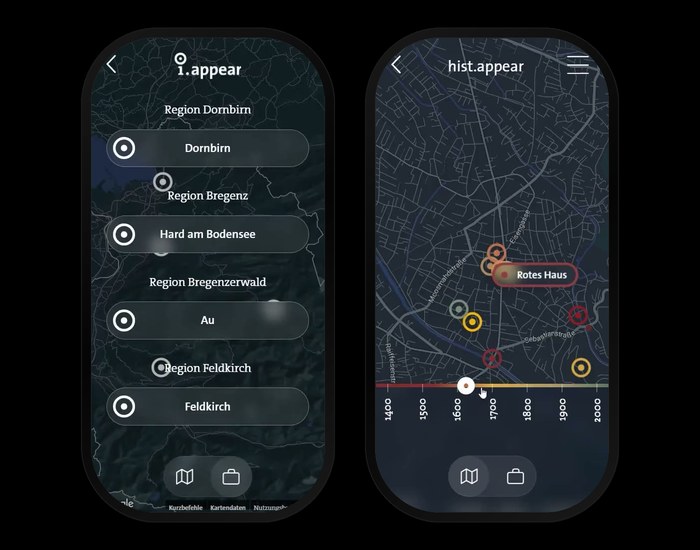
A digital walking tour is a location-based web experience that opens up a city or municipality through fixed locations and storytelling. Map, history and place come together in a website that runs in the browser – no download, no account, no app. At every location, audio, text, images and – depending on the concept – 3D models or augmented reality open up.
For municipalities, tourism boards and cultural institutions, the format is a no-nonsense tool: a city tells its own story without anyone needing to guide a group or show up at a fixed time. The more interesting question is therefore not what a digital walking tour can do technically – but: What makes a good one different from a mediocre one?
This guide answers both questions. It draws on the practice of i.appear, a Vorarlberg-based platform with currently 10 tours and 80 locations across 4 regions.
Definition: What a digital walking tour is – and what it isn’t
Three distinctions make clear what we’re dealing with:
Not a classic audio guide. A digital walking tour doesn’t work only acoustically. Audio remains important, but all content can also be read or viewed. That makes the tour accessible – in noisy environments, in groups, for people with hearing impairments.
Not an app. A modern tour runs as a WebApp in the browser. No app store, no installation, no permissions, no storage space. Whoever opens the link is in the tour. Whoever puts the phone away has left nothing behind on it.
Not a digitised fold-out map. A PDF with clickable points isn’t a digital walking tour. What makes the difference is the interplay of map, narrative and place: content that opens up at the location, in the chosen language, in the order the visitor chooses.
The shift from printed material to web-based experiences took around 15 years. Early attempts were app-fixated and tedious to install. Only today’s generation of WebApps delivers on what was promised from the start: location-based history without friction from the technology.
What municipalities use digital walking tours for
In practice, digital walking tours cover three very different needs. It’s worth keeping them apart – the design decisions are different in each case.
Tourism and regional identity
Tourists often arrive at times when classic guided tours aren’t running – at the weekend, on a Sunday morning, in November. A digital tour is always there, in the language the guests bring along, without booking. For municipalities, it’s a form of “passive hospitality”: those who want it, find something. Those who don’t aren’t addressed.
At i.appear, this layer is covered by the i.dentity category. Examples:
- Innenstadt erleben and Oberdorf entdecken in Dornbirn (eleven locations each)
- Augmented reality tour at the Messepark with the talking tree – a childhood memory that has returned as a 3D model
Urban history and cultural mediation
Urban history mostly happened at places that are still there today – but they look different now. A digital tour makes this difference visible: historical photographs, archival sources, audio narratives at the original scene. Here, the quality of cultural mediation becomes the decisive question.
At i.appear, this layer runs under i.history. Six practice examples are listed further down in this post.
Education
School tours are a field of their own, where students themselves become authors. This layer – at i.appear under i.grow – is a topic in its own right and is covered in depth in the post on the new mandatory subject Media and Democracy.
Practice examples: digital walking tours in Vorarlberg
The following tours show the range of the format – within the same technical framework, but with very different ways of telling, sources and audiences.
Stadtspuren – industrial history along the Dornbirner Ach
18 locations along the Dornbirner Ach, content developed by the Dornbirn city archive (Werner Matt, Klaus Fessler), illustrated by Nikolay Uzunov, designed by Sägenvier. A companion book is available at the city archive. Along the walk, the locations are also physically anchored – through seating and information boards.
hist.appear – 600 years of Dornbirn history
The platform’s first tour. Its content is based on a teacher-training master’s thesis at the University of Vienna, funded by the Austrian Federal Ministry of Arts, Culture, the Civil Service and Sport, in collaboration with the Dornbirner Geschichtswerkstatt (Dornbirn History Workshop).
Barockbaumeister – Franz Beer narrates in person
In Au in the Bregenzerwald, the tour lets Franz Beer speak as a historical figure – from the 18th century, of his apprenticeship, his travels, his buildings around Lake Constance. The tour is part of the research project Digital In&Out with vorarlberg museum, the University of Konstanz, the Barockbaumeister Museum Au and the FH Vorarlberg.
See Runde – social history in Hard on Lake Constance
The tour follows the street sweeper Fiffi, a real Harder person, through the social history of the place – the poorhouse, the maternity ward, the dissecting house. No touristic polish, but everyday life and vulnerability, told at concrete buildings.
Frauenspuren – Dornbirn (May 2026)
300 years of women’s history, made visible at the buildings in front of which the locations stand: an inventor, a market woman, Vorarlberg’s first female doctor, a social democrat, a Nazi perpetrator. The content is based on the book Frauenspuren by Roswitha Fessler from the Dornbirner Schriften series. Illustrated by Lisa Althaus, audio in German and English.
125 Years – 125 Pictures (2026)
Launches for the 125th anniversary of Dornbirn’s city elevation. 125 pictures, spread across the city, tell of everyday life and change over the last 125 years.
What connects these tours isn’t the technology – but sources, care and a concrete place.
What makes a good digital walking tour
Across the German-speaking region, many digital walking tours have emerged in recent years – some excellent, others superficial. From practice, four quality criteria can be drawn.
1. Solid sourcing
Whoever tells history needs sources. Archive work, contemporary witness interviews, collaborations with historians or cultural institutions aren’t luxury options, but the minimum requirement so that a tour doesn’t spread false or carelessly researched content.
Rule of thumb: If you can’t name where a claim comes from, it doesn’t belong in the tour.
2. Narrative quality
A dictionary entry turns 600 years of city history into a graveyard. A story turns it into a walk. The difference lies in dramaturgy: who is the protagonist of this location, and why should I be interested in them?
For a typical location, a length of 400 to 800 words in the text and 2 to 4 minutes in the audio has proven effective. Shorter feels abrupt, longer doesn’t get finished while walking.
3. Design craft
A poorly designed location signals: this doesn’t matter. Clear typography, legible contrast, considered image choices, calm interactions – these aren’t decoration, but mediators. A tour that has been taken seriously in its design will also be taken more seriously in its content.
4. Accessibility
Mobile first, short loading times even with mediocre reception, good contrast, plain language, multilingual support. This isn’t a bonus programme. If a third of visitors don’t make it to the first location for reasons of time or because of technical hurdles, the tour has failed.
Privacy: by design, not by tracking
On a digital walking tour, people walk through public space with their smartphone. The device knows their location, their movement patterns, often a lot more. Whoever develops a tool that runs on this device is making a decision about what to do with that data.
i.appear has opted for Privacy by Design:
- No app installation, no permissions on the device
- No registration, no email address, no account
- No data collection on usage behaviour, no location logs, no analytics trackers
- No advertising
- GDPR-compliant, without end users having to take care of it
This decision has a technical consequence: it isn’t traceable in a dashboard how many people visited which location. In its place comes what already works in public space anyway – feedback from municipalities, schools, tourists, teachers. Quality assurance through relationship instead of through tracking.
For municipalities and cultural institutions that work with public funds and have to commit to GDPR-compliant solutions, this simplifies the legal situation considerably.
How a digital walking tour is made: the workflow
A digital walking tour isn’t a quick shot. Whoever wants a good result typically plans for several months – research, texts, audio recordings, image rights, testing, iteration. Whoever opts for a good tour opts against a fast one.
The workflow runs in three phases:
1. Kick-off – A conversation about the idea, the place, the audience. A municipality can bring a finished plan along, or develop one together with i.appear.
2. Concept – Editorial line, locations, media formats (audio, image, 3D, AR), timeline, costs. This is also where it’s decided which partners are involved – city archive, museum, tourism board, schools.
3. Implementation – Research, production, testing, publication. Throughout, work happens together with those involved so that the tour can be cared for after publication.
The exact service packages are documented on the workflow page of i.appear (in German).
Frequently asked questions
Do visitors need an app to take part in a digital walking tour?
No. A modern digital walking tour runs as a WebApp in the browser. There is nothing to install and no permissions to grant.
How long does it take to create a digital walking tour?
Several months. Research, texts, audio recordings, image rights, testing and iteration all take time. If you want a good result, you plan for it.
What happens to visitors’ location data?
With i.appear, nothing. The platform works by Privacy by Design: no registration, no data collection, no analytics, no advertising. GDPR-compliant with no effort for end users.
Can existing content – city archive, book, research – flow into a tour?
Yes. Several i.appear tours grew out of such collaborations – for example Stadtspuren with the Dornbirn city archive (with a companion book), or Barockbaumeister within the Digital In&Out research project together with vorarlberg museum, the University of Konstanz and the FH Vorarlberg.
Closing: a second layer over the city
A good digital walking tour takes nothing away from the existing city history – on the contrary. It makes it visible in more places, for more people, in more languages, at more times. It doesn’t replace a tour guide, but it adds a form to her work that is always there when someone needs it.
A bad digital walking tour, by contrast, is noise: it looks like cultural mediation but is just an advertising channel with location reference. The difference lies not in the technology, but in the care of the content and the clarity of the design decisions.
For anyone thinking about a digital walking tour in their own municipality, museum or tourism location – the most honest first question isn’t “What does it cost?”, but: “What do we actually want to tell, and how do we know it’s true?” Whoever has a good answer to this question has the most difficult part behind them.
→ Overview of all i.appear walking tours
→ Workflow & Services (in German)
→ Showcase: awards and research projects (in German)